
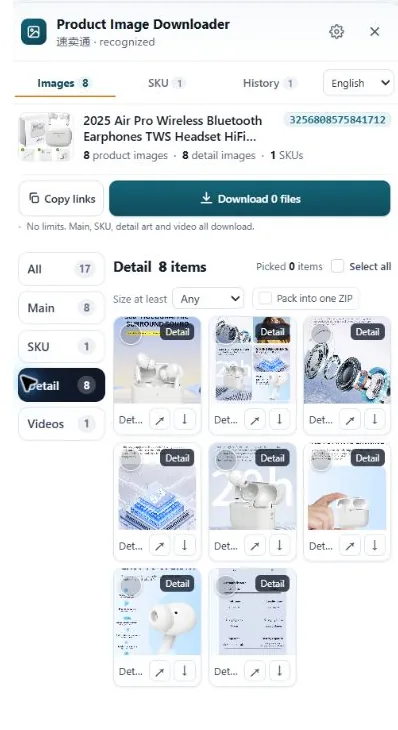
AliExpress usually gives you more to work with: bigger originals from good sellers, a dedicated photo per SKU option, and long detail stacks full of specs. Temu pages look cleaner and more consistent, but the underlying files are often mid-resolution, option images are thinner, and the detail section is shorter. On both platforms the individual seller matters more than the logo at the top of the page.
First, the thing nobody says out loud
Neither platform creates these photos. Suppliers upload them, and both sites then generate resized, compressed display copies for the page. So a comparison like this is really about two things: what sellers tend to upload on each platform, and how much of it the page lets you reach. Any tool, ours included, can only hand you the largest file the page exposes. It cannot sharpen an original that was uploaded small.
With that said, the patterns below hold across a lot of listings, and they decide which platform you should hit first depending on the research job.
Image quality and originals
Temu optimizes for a fast, uniform app feed. On-page images are compressed hard, so listings look soft even when the underlying file is decent. Download the actual file and it improves, sometimes noticeably. But Temu's supply chain runs on speed, and a lot of suppliers upload mid-resolution photos to begin with. Expect usable files, not print files.
AliExpress is a wider spread. A serious store uploads large gallery images, often 1500px and up, with sharp detail shots. A lazy dropship listing uploads whatever the factory sent, sometimes under 800px. The displayed images also carry size suffixes such as .jpg_960x960, and trimming that suffix often reaches the bigger original. The ceiling on AliExpress is higher. The floor is lower too.
SKU images and labels: AliExpress wins this round
If your research question is "what does the blue XL version actually look like," AliExpress is built for it. Options carry text labels, and most multi-variant listings attach a dedicated image to each option. Download those images with their labels attached and you can rebuild the variant structure on paper without guessing.
Temu handles options more loosely. You get option images, but they are frequently the same gallery photos reused at thumbnail size, and two options can share one photo. The mapping between photo and variant is there on the page; it is just less explicit, and it blurs further once files land in a folder. If variant accuracy is the whole point of your research session, start on AliExpress and use Temu to cross-check price and presentation.
Detail stacks: more on AliExpress, tidier on Temu
| What you are comparing | AliExpress | Temu |
|---|---|---|
| Typical original size | Varies widely by seller; good stores reach 1500–2000px+ | Often mid-resolution; display copies are compressed harder |
| SKU / variant images | Dedicated image per option is common, with text labels | Option images exist but often reuse gallery photos |
| Detail images | Long seller-built stack: specs, size charts, factory shots, marketing banners mixed together | Shorter, more standardized detail section |
| Biggest annoyance | Duplicates, watermarks from some sellers, inconsistent quality | Soft files and thin variant information |
The AliExpress detail stack is where the specifications live: dimension diagrams, size charts, material close-ups, occasionally the original factory photos. It is also a mess, because sellers build it themselves and repeat images. The Temu detail area is more standardized and faster to scan, but it often tells you less. For a spec sheet, AliExpress. For a quick read on how a product is being pitched to consumers, Temu's page is the faster skim.
So which one should you research first?
- Specs, sizes and variant structure: AliExpress. The data is there, buried in the detail stack and the SKU set.
- How the product is presented to shoppers: Temu. Its pages reflect a tighter, more curated pitch, which is useful if you are studying angles and bundles.
- Biggest usable photos: AliExpress, from established stores. Check the file dimensions before you celebrate, because the same category holds tiny uploads too.
- Price-led comparison of the same item: both, and keep the image sets in separate folders. The photos cross-contaminate fast once they are mixed.
Collecting from both with HiRes
HiRes works on product pages at both platforms and reads each page the same way: main gallery in one group, variant images with the option labels the page provides in another, detail images in a third. That consistency matters when you are comparing the same product across the two sites, because the folders line up group for group instead of one site giving you a neat set and the other a pile.
Two limits to plan around. First, HiRes keeps labels only where the page exposes them, so Temu's fuzzier option mapping stays fuzzy in your download; we do not guess at labels. Second, lazy-loaded detail images only exist once the page loads them, so scroll through the listing before opening the panel, especially on AliExpress where the description stack is long. Downloads are free for individual files, everything runs locally in your browser, and your collected images are never uploaded anywhere.
Questions people ask
Which platform has better product images overall, Temu or AliExpress?
AliExpress, more often than not, but it swings by seller. Established AliExpress stores frequently upload large, detailed image sets with proper SKU photos. Temu sets look tidier on the page, yet the underlying files are often mid-resolution because that is what the supplier uploaded. Judge listing by listing, not platform by platform.
Why do downloaded Temu images look clearer than the page?
Because the page is showing you a heavily compressed display copy, and the file underneath it is less compressed. Downloading gets you that underlying file. It cannot get you more resolution than the supplier uploaded, which on Temu is frequently modest, so the improvement is real but capped.
Which platform is easier for SKU and variant research?
AliExpress. Its listings usually attach a dedicated image to each option and label options with text, so the mapping between a photo and a variant survives the download. Temu option images are often just small gallery thumbnails, and the same photo can serve several options, which makes the mapping fuzzier.
Can a downloader fix a low-resolution original?
No. A downloader can fetch the largest file a page exposes and avoid the extra compression of screenshots, but it cannot invent detail the supplier never uploaded. If the original is 800px, every honest tool gives you an 800px file.
Compare both platforms the same way
HiRes groups gallery, variant and detail images into the same structure on Temu and AliExpress, so cross-platform research stays organized. Free for individual downloads.
Get HiRes for Chrome